You Cannot Have One Without the Other

You Cannot Have One Without the Other
Easter Sunday | 1 Corinthians 15:1–8, 17–20 | Romans 4:25
Liberty Baptist Church | Winchester, Tennessee
---
There is a temptation that creeps into Easter Sunday every year.
It is the temptation to preach only half the gospel.
Some people love the cross so deeply that they never quite make it to the empty tomb. Others are so drawn to resurrection morning that they race past Good Friday as though the blood and the suffering were merely the unpleasant prelude to the real celebration. But the Apostle Paul will not let us do either. And if we are honest, neither should we.
THE GOSPEL PAUL DECLARED
In 1 Corinthians 15, Paul lays out what he calls, with great urgency, the gospel — not a gospel, not one version of good news among many, but the one upon which your entire standing before God depends. And when he defines it, he binds two inseparable realities together:
"For I delivered to you first of all that which I also received: that Christ died for our sins according to the Scriptures, and that He rose again the third day according to the Scriptures." — 1 Corinthians 15:3–4
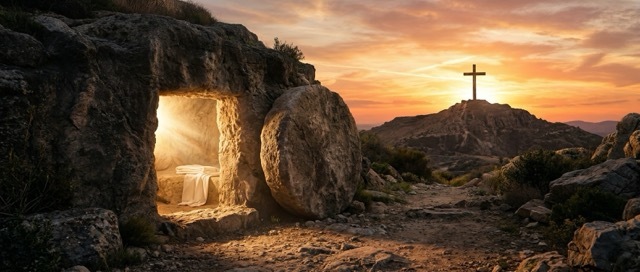
Neither event can be detached from the other. The cross without the resurrection is a tragedy. The resurrection without the cross is a fantasy. But together — together they are salvation.
THE CROSS: THE PLACE WHERE SIN WAS PAID
Paul does not begin with the resurrection. He begins with the death. "Christ died for our sins." That three-letter preposition — for — carries the weight of the entire Christian faith. Not around our sins. Not near our sins. For. In the place of. As a substitute for.
The theological word for this is propitiation — the satisfying of God's righteous wrath against sin. Romans 3:25 tells us that God presented Christ as a propitiation through faith in His blood. The wrath that belonged to us fell upon the Son of God at Calvary. He became sin for us (2 Corinthians 5:21). He bore our curse (Galatians 3:13). He was forsaken so that we would never be forsaken.
Think of a man convicted of a crime committed decades before he was caught. In the years between, he built a life — a family, a community, a reputation. None of it erased the debt. The law does not forget. It cannot. And neither can a holy God simply ignore the debt of sin. What we needed was not for God to look the other way. We needed someone to pay what we owed.
That is exactly what the cross is. It is the legal satisfaction of divine justice. God is not loving at the expense of being just. At the cross, both His love and His justice are perfectly displayed — at the same moment, in the death of His own Son.
But here is what we must not miss: a dead Savior cannot save anyone. If Jesus died on Friday and remained in that tomb, the cross accomplished nothing. Our sins would still be counted against us. This is why Paul drives forward.
THE RESURRECTION: THE PROOF THAT THE PAYMENT WAS ACCEPTED
Romans 4:25 may be the most compressed summary of the gospel in all of Scripture:
"[He] was delivered up because of our offenses, and was raised because of our justification."
He was delivered — the cross. He was raised — the resurrection. And Paul tells us why He was raised: for our justification. The resurrection is not a separate miracle stapled onto the end of Good Friday. It is the Father's declaration that the payment was accepted. The debt is cleared. The case is closed.
Imagine you owe a debt so enormous you cannot begin to repay it. A friend steps in and says, "I will settle this for you." He walks into the bank, makes the payment, and walks back out. You know the debt is paid — not because you trust his good intentions, but because he walked back out. If the payment had been rejected, he would not have been released. The empty tomb is Jesus walking back out of the bank. The Father accepted the sacrifice. The debt of sin is paid in full.
This is why Paul's words in 1 Corinthians 15:17 are so striking: "If Christ is not risen, your faith is futile; you are still in your sins." He gives us no middle ground. Either the resurrection happened and your faith means everything, or it did not and your faith means nothing. But then he pivots with those two life-altering words — "But now."
But now Christ IS risen. He is the firstfruits — the first of many who will be raised. Because He came out of that grave, everyone united to Him by faith will come out of their grave as well.
WHY YOU CANNOT HAVE ONE WITHOUT THE OTHER
The cross without the resurrection leaves us with a martyr, not a Savior. History is full of people who died for noble causes. Their deaths may inspire us, but they cannot redeem us. If Jesus stayed in that tomb, He is the greatest teacher who ever lived and the most tragic figure in human history — nothing more.
But the resurrection without the cross leaves us with a miracle, not a gospel. What would it mean for a man to rise from the dead if that man had not first died in our place? It would be astonishing. But it would not save you. It would not deal with the problem of your sin. A resurrection with no cross is a wonder. A resurrection following the cross is salvation.
The healthy Christian life runs back and forth between these two truths. When your conscience rises up against you — when you lie awake carrying the weight of what you have done — you go to Golgotha. You hear Jesus say, "It is finished." Not beginning. Not improving. Finished. Paid. Done.
And when death frightens you — when you stand at a graveside and feel the cold wind of your own mortality — you look at the empty tomb. You hear the angel say, "He is not here; for He is risen, as He said." And you remember that the One who conquered death is the One in whom you have placed your faith.
HAVE YOU RECEIVED IT?
Paul does not just describe the gospel in 1 Corinthians 15. He says the gospel is something you receive, and something in which you stand, and by which you are saved. That is three layers of personal engagement — not merely knowing, but trusting.
Some of you have been in church your entire life and have never crossed that line. You know the story. You know the vocabulary. But there is a difference between knowing the story of the rescue and being rescued.
Easter Sunday is not only a celebration for those who are already saved. It is an invitation to the one who has never yet trusted the Savior. Christ died for your sins. He rose for your justification. That righteousness — His perfect obedience, His atoning death — is offered to you freely. Receive it. Trust Him.
---
Next Sunday we continue the Word. Don't miss it. Bring someone who needs to hear this gospel.
Liberty Baptist Church | 11:05 AM | Winchester, Tennessee
#LibertyBaptist #WinchesterTN #Easter #GospelTruth #HeIsRisen